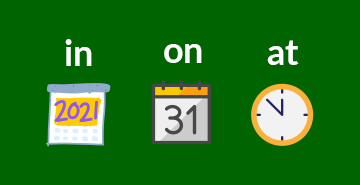
Prepositions of Time – in, on, at
Learn how to use in, on, and at to talk about time. This guide explains which preposition to use with parts of the day, days, dates, months, years, seasons, and exact times, with clear rules and simple examples.
How to use
Use 'at' for an exact time on the clock or a specific moment in the day (like mealtimes). It's the most precise of the three prepositions.
- I wake up at 7:00 AM.
- The movie starts at midnight.
- I'll call you at dinnertime.
Use 'on' for days of the week, specific calendar dates, and special named days. If it's a single day, you likely need 'on'.
- We have a meeting on Monday.
- My birthday is on October 15th.
- I'm going to the beach on Christmas Day.
- Do you work on weekends?
- She plays tennis on Fridays.
Use 'in' for months, years, seasons, centuries, and general times of day (morning, afternoon, evening). This is for the broadest time frames.
- I study English in the evening.
- The company was founded in 1999.
- It often snows in winter.
- We go on holiday in August.
- That castle was built in the 12th century.
Do not use in/on/at with the words 'last', 'next', 'this', or 'every'. These words are already acting as time markers and don't need an extra preposition.
- I will see you on next Friday. ❌ → I will see you next Friday. ☑️
- She went to Minsk in last year. ❌ → She went to Minsk last year. ☑️
- We are busy on every morning. ❌ → We are busy every morning. ☑️