Subordinating Conjunctions
A subordinating conjunction joins two parts of a sentence. It introduces a dependent clause, which cannot stand alone, and connects it to an independent clause, which can be a complete sentence. Learn the rules of how to use subordinating conjunctions to join two ideas in one sentence.
How to use
Different conjunctions express different relationships between ideas.
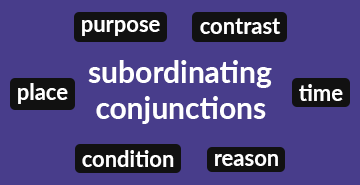
- Time: when, while, as soon as, before, after, until, once, since, as
- Reason: because, since, as
- Condition: if, unless, as long as, in case, assuming that
- Contrast: although, though, even though, while
- Place: where, wherever, everywhere, anywhere
The most important rule is choosing the correct conjunction to show exactly how the two ideas relate. Are you showing when something happened? Why it happened? Or despite what happened?
- Time (When): "I will call you as soon as I get home."
- Reason (Why): "She passed the exam because she studied every day."
- Condition (Under what circumstance): "You will succeed if you never give up."
- Contrast (Despite): "He went for a run although it was raining."
- Place (Where): "She will follow him wherever he goes."
If the dependent clause (the one starting with the conjunction) comes first, you must separate it from the main clause with a comma.
- If you study hard, you will pass the test.
- Because he was tired, he went to bed early.
- After we finished dinner, we watched a movie.
- We watched a movie after we finished dinner.
- She smiled because she was happy.
- I'll wait until you are ready.
Because the dependent clause is not a complete thought, it cannot be written as its own sentence. This is one of the most common mistakes in English writing.
- Although she tried. ❌ → Although she tried, she didn't win. ☑️
- Because I was tired. ❌ → I went to bed early because I was tired. ☑️